
Art and Belonging
Loneliness is not always something we can observe from the outside.

My favorite museum in Utah is in the beautiful town of Springville, a community that proudly calls itself “Art City.” The museum holds special meaning for me because it was the first place where my work was accepted not as an art quilt, but in the textile category as a stitched painting.
Since then, I have had the pleasure of being accepted into multiple competitive juried exhibitions there, most recently the Spring Salon.
This week I am working on an entry for a unique and highly selective exhibition called “In this Together.: Art, Belonging and the Urgency of Social Connection” The exhibition is a collaboration with BYU researcher Dr. Julianne Holt-Lunstad, whose work on loneliness and social connection has been cited by organizations and publications including the World Health Organization, CNN, Scientific American, and The New York Times. Only 15 artists will be selected.
Normally, I begin with my own ideas and work through them until they are fully expressed in a finished piece. Once I am ready to call the work complete, I look for the right place to share it with an audience.
Years ago, I stepped away from the call-for-entry treadmill of creating pieces to fit themes determined by someone else. This call felt different. As I read the supporting research, it opened a new way of seeing an existing series of work. The theme did not feel imposed from the outside; instead, it revealed something already present in the images. I began to recognize a deeper connection between my figures and the quiet, complex experience of loneliness—the perceived gap between the connection we long for and the connection we experience.
My source photographs are from the decade that followed World War II. It was time when social institutions such as churches, civic organizations, neighborhood associations, and multigenerational families played a larger role in everyday life. Since then, increasing mobility, smaller households, longer periods of living alone, and changes in how we communicate have altered the way people connect. Today, nearly half of American adults’ report experiencing loneliness at least some of the time, leading the U.S. Surgeon General to identify social isolation as a major public health concern.
Loneliness is often understood as a private emotional experience, but research shows that it is also a serious public health issue. Social isolation has been compared to the health risk of smoking 15 cigarettes a day, and it has been linked to increased risks of dementia, stroke, physical and mental illness, and premature death. Its impact reaches beyond the individual, affecting families, communities, workplaces, and the broader economy.
Because this subject deserves attention, art has an important role to play. In a variety of forms, art can highlight what statistics alone cannot fully express, inviting the public to pause, look more closely, and engage with the human experience behind the research. Artists can add meaning to the discussion by giving visible form to feelings, questions, and social patterns that might otherwise remain abstract.
“Loneliness is more about the perception of the discrepancy between one’s desired level of connection and actual connection.” Interview Dr. Holt-Lunstad, NVEA Connect Report 2025
I am submitting Third Wheel because it visually captures the experience of feeling alone, even while sitting with others.
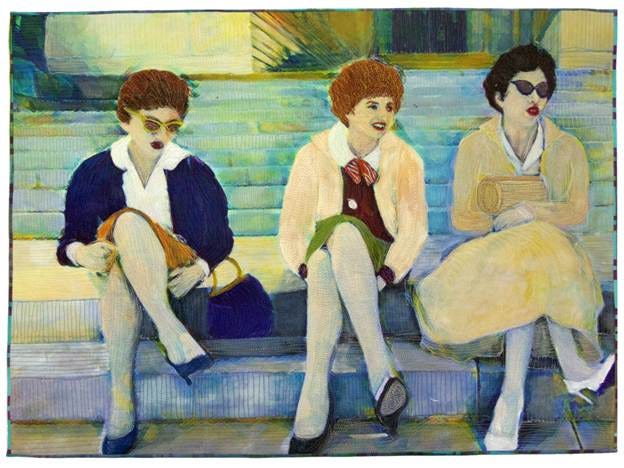
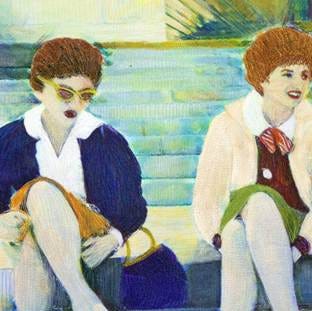
In the painting, three young women sit on the steps of a building, as though they may be on a lunch break. The two women on the right appear to be looking toward the same person or object, their faces turned in the same direction. The third woman, seated slightly apart on the left, looks downward, her attention turned inward.
As viewers, we do not know what she is thinking. Perhaps she is adjusting her skirt. Perhaps she is bored with the conversation. Or perhaps she is experiencing the quiet distance that can exist even in the presence of others. That uncertainty is central to this piece.
Third Wheel illustrates the idea that loneliness is not always something we can observe from the outside. A person may appear to be included in a group and still feel separate, unseen, or disconnected. The real measure often exists in the individual’s internal dialogue: the private perception that a desired connection is not being met by the connection actually being experienced. This is what makes loneliness so difficult to identify, represent, or measure.
The problem may begin with the word itself. If loneliness is understood only as being physically alone, then we miss the more complicated reality of feeling alone in the presence of others. The interview also raises an important question about whether the data showing an increase in loneliness over time is conclusive. Perhaps a more useful way to approach the issue is through the broader idea of social connection, which allows room for both absence and presence, both measurable behavior and unseen emotional experience.
As an artist, I am interested in people. They are my subject matter, but they are also the center of my life outside the studio. I value the solitude required to make work, yet I also recognize that my relationships with other people support both my creative process and my physical health. The community I share with local artists creates a kind of connection that cannot be replicated through Facebook groups, Patreon, or online classes.
As the research suggests, social technologies may mimic connection, but they do not replace the presence, nuance, and mutual attention of face-to-face interaction. I see that same value in the other communities I belong to, including book club, Mahjongg, and a few charities. These relationships feel deeper and more intentional than the social life I once built primarily around my children’s activities or my workplace. They remind me that connection is not simply a pleasant addition to life; it is part of what sustains us.
For me, this exhibition is an opportunity to bring my personal experience, my artistic subject matter, and the public conversation about loneliness into the same space. If Third Wheel invites viewers to pause and consider the unseen distance that can exist between people, then it also invites them to consider the connections that make us healthier, more creative, and more fully human.
Until Next Time
Margaret