
Bright Spots
Training my brain to return to patterns which created my best work

How to human on Substack is written by Matt Dahlia. In his post “Bright spots” he writes:
“In anything you want to get better at, you have to deposit your successes into your internal memory bank. You have to intentionally remember the moments when you did the right thing in order to train your brain to replay those successful patterns in the future.”
Reading Matt Dahlia’s insights prompted me to reflect on the successful moments in my own life as an artist. Like many others, I often find myself focusing primarily on the most recent experience evaluating what went well or what could have gone better. For instance, I had a strong period of sales of landscapes during November and December at my local gallery plus a nice commission of a family portrait. In January and February despite new work and the gallery getting lots of traffic during an art festival I didn’t sell anything.
Instead of celebrating the earlier achievements, my attention became fixated on the lack of sales in the subsequent months. Since then, I’ve been in a holding pattern. I realize that the challenge might not only be in recognizing success when it occurs, but in training my brain to return to patterns which created my best work.
Yayoi Kusama, the dot queen; is a famous example of being able to return to success.
Kusama’s first breakthrough came soon after she moved to New York in 1958. In 1959 she had a solo exhibition at the Brata Gallery, where she showed her large-scale Infinity Net paintings—vast canvases covered edge to edge in obsessive, looping white arcs.
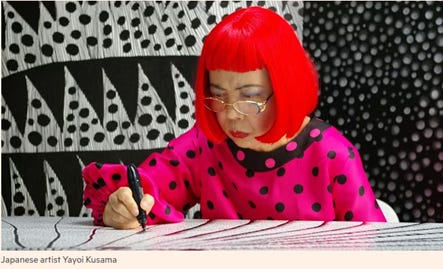
Her work stood out in the emerging Minimalist scene for its intensity and repetition. Critics took notice, and she soon exhibited alongside artists associated with Minimalism and Pop Art. Through the early 1960s she staged increasingly bold happenings and installations, including mirrored environments that would later evolve into her celebrated Infinity Mirror Rooms. For a time, she was at the center of avant-garde experimentation in New York.
By the early 1970s her momentum slowed dramatically. The New York art world shifted, some of her innovations were absorbed into mainstream movements without fully crediting her. She struggled with mental health and financial instability. In 1973 she returned to Japan where her work was initially met with little enthusiasm. This period marked a relative withdrawal from international visibility. Yet it was not the end—rather a quieter chapter before a powerful resurgence in the late 1980’s. A major retrospectives and her presentation at the 1993 Venice Biennale reestablished her global presence.
Throughout her life, Kusama has returned repeatedly to her obsession with dots. For her, they are not decorative but essential—both a repetition that calms the mind and a way of dissolving the self into something larger and infinite. Living voluntarily in a psychiatric hospital in Tokyo since the 1970s, she walks daily to her studio to work.
Her perseverance lies in that steady return: to the studio, to the canvas, to the dot—transforming personal struggle into a practice of endurance and boundless imagination. Kusama’s bright spot is her obsessive process which expresses the infinite. She didn’t return to a gallery or a place. She was returning to her central reason for making art.
As a child in Hawaii, I went to art classes at the Honolulu museum. They were held in basement classrooms, but students were taken upstairs and did drawings in the museum and the museum’s garden spaces. When we moved to the mainland there wasn’t an art museum, so I found a home in the high school art room. I found success there and went on to study art in college.
During my elementary school years, I struggled greatly with spelling. The structured Catholic school curriculum I attended made it clear that spelling was essential to writing, and this rigid environment left me feeling boxed in. As a result, I developed a fear that I could not be a writer if I did not excel at spelling. This anxiety persisted into adulthood—when I took teacher certification tests, I received excellent scores on the written portions but barely passed the spelling segment. Fortunately, the visual language of art provided another outlet for self-expression, allowing me to communicate creatively without the constant worry of making spelling mistakes.
Eventually, I overcame my fear of spelling errors with the help of tools like spellcheck. In college, I was required to write papers, and in graduate school, I wrote and published a thesis. Writing about art became the way I replaced my fear with a desire to share my passion for artists through the written word. Today, I am embracing writing as a form of expression, finding joy in sharing my thoughts and experiences. It has become my second favorite creative outlet, complementing my work in the visual arts.
Computer spell check application was introduced in 1971. It became available on personal computers in the 1980’s. Spell check became standard in Word in 1990’s.
Throughout both college and graduate school, the history of photography and film stood out as some of my favorite courses. I quickly became a devoted fan of the medium, drawn to its ability to preserve a moment in time and tell stories. The study of these subjects deepened my appreciation for how photographs and films capture not only images, but also the emotions, culture, and history embedded within each frame. This fascination with visual storytelling profoundly shaped my creative outlook, fueling a lifelong passion for art that communicates through imagery as much as words.
More than a decade ago, when I committed myself to art quilting and working full-time in the studio, my fascination with photographic imagery deepened. I started with photographs of my own family, exploring the emotional power and storytelling potential that these images held. To me, a photograph serves as a record—a visual bridge connecting viewers to a particular moment in history, rooted in a specific place and culture.
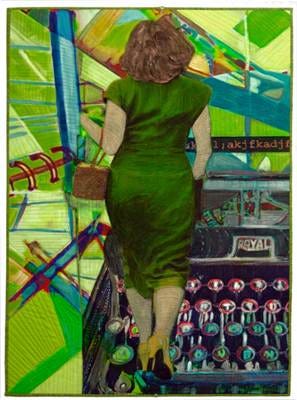
My interest is especially piqued by photographs created during the era of darkrooms and silver prints. These traditional processes captivate me far more than their digital counterparts, perhaps because of the tangible sense of history they convey, and the unique aesthetic qualities produced by analog methods.
My current series starts with a vintage photograph and concludes with an article on Substack that shares the story behind each piece. This series has been well received with most the pieces juried into galleries and museums. This is my source of inspiration where I can keep creating art that tells stories or as Matt Dahlia might say “It’s my bright spot.”
Until Next Time…
Margaret