
Home
Home is fundamentally a place of belonging, acceptance, and ease—where one’s presence needs no explanation.

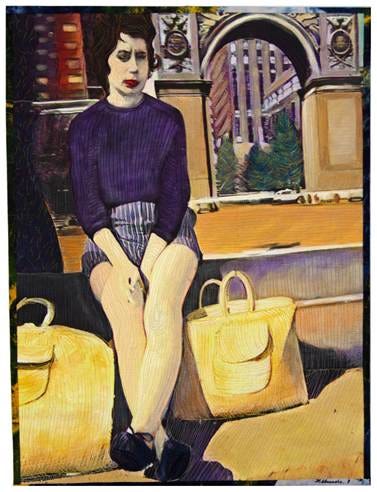
After a week of focused work in the studio, I have finished a new piece tentatively titled “Almost Home.” The artwork portrays a young woman seated in a city park, her feet stretched out into the sunlight. Her eyes are closed, suggesting a moment of rest or escape. She is dressed in shorts and a sweater, complemented by ballet shoes, a choice that hints at both comfort and grace.
Beside the woman lie two woven shopping bags reminiscent of the late 1950s, grounding the scene in a specific era and adding to the narrative of everyday life. In the background, an arch frames the tall city buildings, creating a sense of structure and distance. Beyond the arch, a street runs through the scene, and a tree casts shade nearby. The overall composition conveys the young woman’s exhaustion, capturing a moment of pause and vulnerability within the bustling city environment.
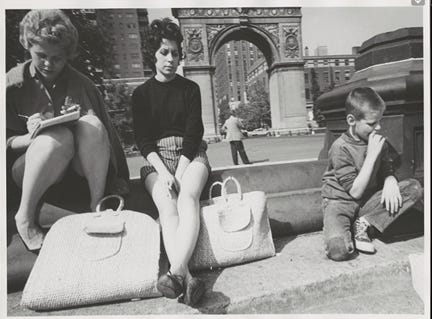
The original photograph was captured in May 1959—just a month before my own birth—by Angelo Rizzuto, a street photographer from New York City. In my artistic process, I treat the photo as a starting point to develop a broader narrative. For this piece, I removed the figure positioned in the middle ground, cropped out the boy on her right, and erased the woman taking notes. My intention was to make her the focal point of the story.
Amid the heat and noise of the city, the young woman chooses to sit quietly, allowing herself a breath of calm after the exertion of a simple errand: getting groceries. The journey—descending stairs, maneuvering through crowded buses and bustling streets, stopping at various shops—may be a routine she undertakes every week, sometimes with children in tow. These tasks accumulate, making her pause not merely a break, but a conscious act of self-care, a brief opportunity to restore her strength before continuing onward.
By translating the original black and white photograph into color, I can breathe new life into the scene. The process of adding color transforms the moment from a distant memory into something more immediate and vivid. Shadows, the woman’s outfit, and the tree to her left ashare a cool violet hue, creating a sense of unity within the composition. In contrast, the background colors are blended with yellows, establishing a subtle division across the artwork.
This division aligns with the classic compositional strategy of the one-third/two-thirds split or the pleasing triangular arrangement often found in still life paintings. The use of color not only enhances the visual balance of the piece but also serves as a nod to the capacity to remain cool in a hot environment. Through these choices, the artwork conveys both emotional and atmospheric qualities, deepening the viewer’s connection to the subject and her surroundings.
In developing this series, I am intentionally using photographic images of women from the late 1950s as a foundation for portraying different states of being. These portraits are not simply representations of individuals but serve as visual explorations into emotional and psychological conditions experienced by people—especially women—during that era.
This artwork offers a glimpse into a state of being—a fleeting pause in which a woman, captured by a camera 66 years ago, takes a moment to gather herself and replenish her energy in the midst of daily demands.
A state of being is more than just an isolated feeling; it represents a broader emotional atmosphere that influences how a person thinks, responds, and relates to others. It is the emotional climate that shapes one’s sense of balance, well-being, and presence within the moment. Through this piece, I hope to offer a window into these layered and nuanced states, suggesting the depth of experience that defines a person’s relationship with their surroundings and with themselves.
When I began painting, I found my own state of being closely aligned with that of the young woman depicted in the artwork. Like her, I feel a sense of exhaustion, which resonates with the broader fatigue many people experience in response to the current state of the country and the world. This collective weariness contributes to a longing for normalcy. A desire to return to a country and a home that feels familiar, comforting, and secure.
Home is fundamentally a place of belonging, acceptance, and ease—where one’s presence needs no explanation. More than structure, a home is defined by connection, recognition, and a sense of being welcomed as oneself. Home provides safety and comfort, allowing a person to rest, be authentic, and trust that they belong. It also offers familiarity and routine, where daily rhythms and predictable moments create stability and calm.
Because of the wars and fighting in the Middle East—in places like Palestine, Lebanon, and Iran—so many people have lost their homes. This breaks my heart. They’re left searching for safety, carrying whatever they can, and trying to look after their families. The routines and comforts they’ve always known are gone. Now, instead of feeling safe or settled, they’re packed into crowded rooms or tents, never sure where they’ll end up next.
Losing a home isn’t just about losing a roof—it’s about losing that sense of belonging, the place for memories and daily life. For so many, comfort and protection have been replaced with worry and longing for the way things used to be.
“The opposite of love is not hate, it’s indifference. The opposite of art is not ugliness, it’s indifference. The opposite of faith is not heresy, it’s indifference. And the opposite of life is not death, it’s indifference.” Elie Wiesel
Until Next Time
Margaret
You make a lot of very good points and comparisons. Home is so much more than a roof over your head.