
My Relationship with Time
Acknowledging the passage of time and how deeply it shapes both art and life.

When I began making the printed, painted, and quilted works that loosely fall into the world of “art quilts,” my subject was family. I immersed myself in a collection of photographs taken by my Uncle Tom between the 1930s and the 1960s, framing the pieces as conversations with my past. Later, I shifted to working from cell phone images — conversations with the present. My current series reaches further outward, drawing from photographs made around the year I was born. These are no longer conversations with familiar people, but with a particular moment in time. I frame these pieces as conversations with history.
When I first encountered the art quilt community, I was teaching art in Colorado and had only a limited sense of the medium’s conventions. After joining the Front Range Contemporary Quilters, I naively brought my first art quilt to one of their well-attended critique meetings.
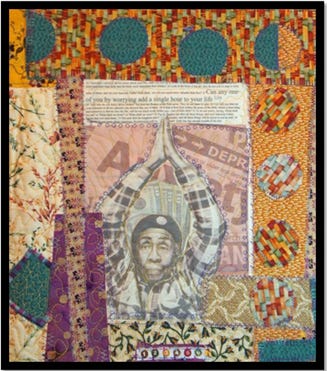
The piece was a fabric collage layered with photo transfers, vintage textiles, and commercial cloth. I was not using traditional piecing or hand-dyed fabric, and the work was neither abstract nor pictorial in any accepted sense. It likely had more in common with Joseph Cornell than with Gee’s Bend. Not surprisingly, the piece was not especially well received. That, however, never troubled me.
At that time, I was deeply engaged with metaphysical and spiritual themes. Like Cornell’s box constructions, my work was intended to function almost as a shrine—something to be viewed slowly and carefully, with every element contributing to the overall meaning. I also incorporated quotations that, at first glance, could be mistaken for decorative pattern, but were meant to reveal another layer of significance.
“Therefore, I tell you, do not worry about your life… Look at the birds of the air; they do not sow or reap or store away in barns, and yet your heavenly Father feeds them.”
Matthew 6:25–26
My photo transfers came from varied sources, including cutouts from vintage magazine ads, postcards, and other ephemera. I organized these materials into compositions grounded in the elements and principles of design. Although the work was not commercial in nature, it did find some success in juried art exhibitions.
Once I felt confident in the structure of these fabric collages, I began working on a larger scale. That shift transformed the shrine-like quality of the earlier, smaller pieces into something different. Two of these larger works now hang in my home, and both were juried into statewide exhibitions as well as included in several gallery shows.
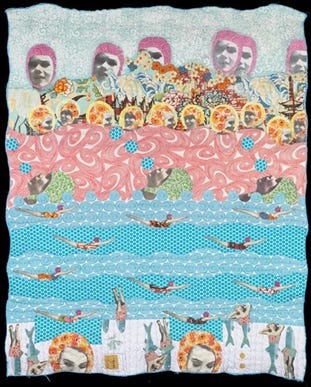
One of these pieces is titled Swimming in the Sea of Love. The title comes from a book and lecture by Deepak Chopra, in which he described the relationship between the human soul and God as a drop in an ocean of love. The drop cannot be distinguished from the ocean itself: it is all water, and it is all love.
My favorite piece hangs in my guest room. “The Sacred Clock of Now”. It is a collage made of a vintage tablecloth sized to fit a card table. At the bottom of the quilt are two figures I called my Breck Hair Girls. They appear in several pieces, including Swimming in the Sea of Love, where I covered their hair with bathing caps. At the center are two alarm clocks. One is a mirror image, with the word now appearing in reverse. The other is an alarm clock marking the passage of time.
Around them is a circular arrangement of images. At 12, 3, 6, and 9 o’clock are photographs of two women from the 1920s, one of whom is my Aunt Margaret Isabel. Between them are dress patterns from the 1940s. Floating around the outer edge is a girl modeling a bathing suit from the 1950s, while at the bottom are women from the 1970s—my Breck Girls.
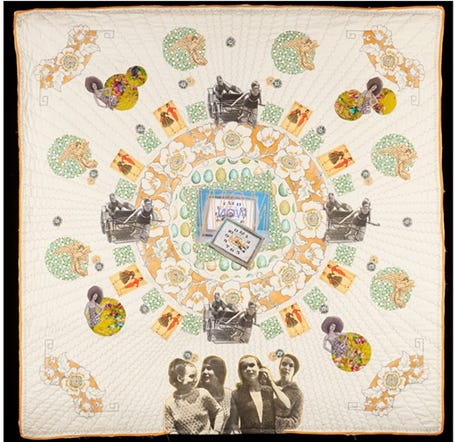
The implied meaning is that time floats through our minds. We live in the past or the future; only rarely do we live in the sacred now.
These two pieces were the last of this series that fizzled out. The year after they were made I was retired, moved and my daughter was married. When I brought my portfolio to be reviewed as a juried artist members of the Studio Art Quilt Associates it was rejected for not being cohesive. That rejection was a gift. I began a new journey that has led me to my recent work which has reached beyond art quilting and is now allowing me to explore beyond the limitations of my own life and of a community that I have outgrown. What surprises me is how looking back I see a deep connection of exploration that has been ongoing. TIME.
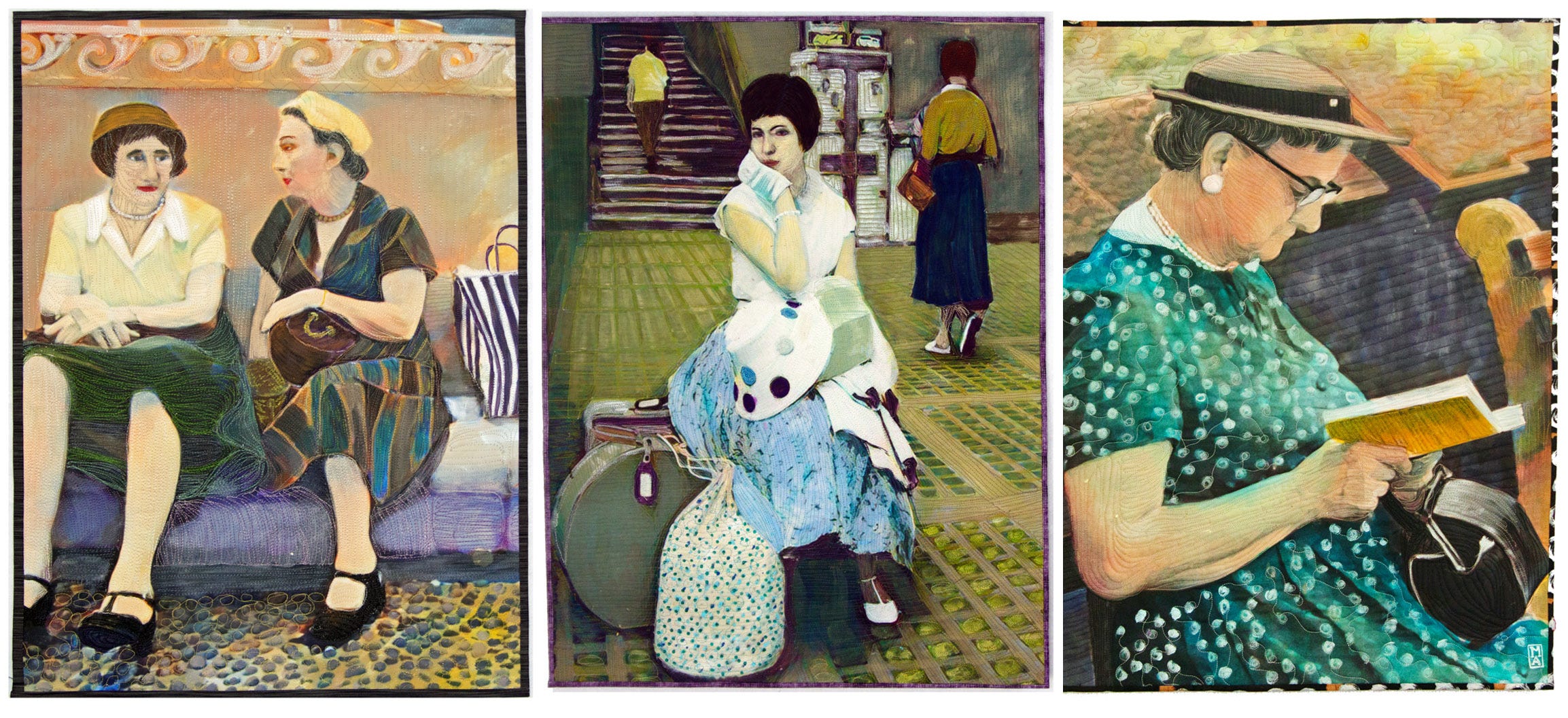
My most recent works have shifted away from portraiture and toward figures placed within specific settings. In each painting, the subject’s relationship to time—how it is marked, endured, or quietly inhabited—has become central.
· Confidants depict two older women in conversation in a park.
· Oh Patience shows a girl waiting on a stack of suitcases in an underground train station.
· The Reader portrays an older woman sitting on a park bench, absorbed in a book.
Time—and the ways people pass through it—connects all three paintings. That theme is deepened by the source material itself, which comes from the late 1950s and early 1960s.
Time may be on my mind because, at sixty-six, I recognize that I am likely living in the last third of my life. Or perhaps it is because the creative process has always been how I make sense of the world. My understanding of life is shaped through history, memory, and observation, and looking back, I can see that time has been present in my work from the very beginning.
Although I work with cloth, I approach it more as a painter than a traditional quilter. I paint my surfaces first, then stitch them, allowing the quilting to add texture, structure, and another layer of meaning. Over time, I have become increasingly interested in surfaces that suggest wear, memory, and change—evidence of what has come before. The stitching becomes less about decoration and more about marking time itself, recording attention, repair, and the slow accumulation of experience.
In the end, my work is not about preserving a single moment, but about acknowledging the passage of time and how deeply it shapes both art and life.
Until Next Time …..
Margaret