
Quilt World Controversy
Is it time for companies to stand up for their core values?

I post on Instagram daily, but I usually spend only a short time browsing the platform. My interests rarely lead me to follow traditional or even modern quilters, with just a few notable exceptions. One account I make a point to follow is “the_badass_quilter,” run by Maddy Kertay. Maddy lives in Tennessee and describes herself as a “liberal fiber artist, dark sewing maven, and vocal advocate for diversity and democracy.” Her Instagram feed stands out because it’s not dominated by political commentary; instead, it’s focused on sharing her genuine self. There’s no sense of pre-packaged content or artificiality—everything about Maddy and her company feels sincere and authentic.
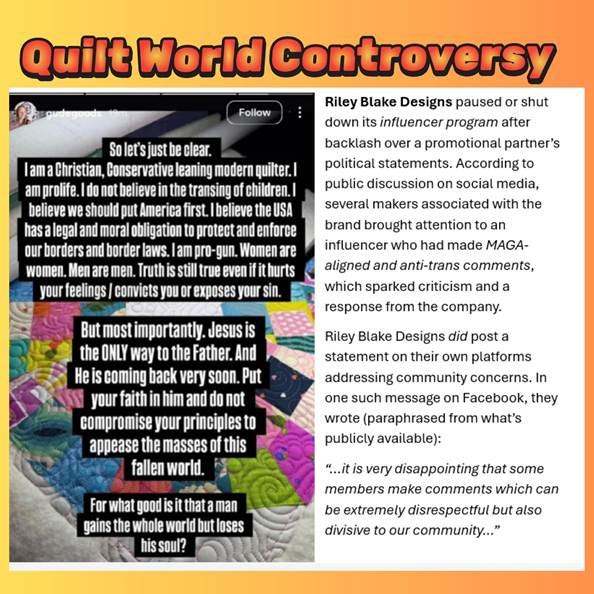
Maddie posted a reel to explain the situation surrounding a Riley Blake Fabrics brand ambassador. On the surface, it appeared that the company ended its relationship with this individual following negative feedback from customers about one of her social media posts.
In her post, the ambassador identified herself as a Christian, Pro Life, and a conservative-leaning modern quilter. She then elaborated on her political beliefs, which aligned closely with the MAGA movement, expressing a pro-gun stance, opposition to immigration, and anti-trans views. Her final sentence made it clear that she was neither interested in nor tolerant of viewpoints other than her own: “The truth is still true, even if it hurts your feelings.” She followed this with a second paragraph offering a biblical justification for her position.
When I first came across the ambassador’s post and the company’s reaction, I didn’t feel compelled to investigate further. However, the insights shared by “the badass quilter,” Maddy Kertay, and other members of the modern quilting community prompted me to reconsider and dive deeper into the issue. Their thoughtful perspectives challenged me to move beyond surface-level judgments and explore the broader implications of the situation.
Maddy began her commentary by affirming the importance of everyone’s right to share their opinions, even when those opinions are offensive to others. She then pointed out that the company’s response—and the values it represents—are a separate matter entirely, stating, “are another kettle of fish.” This distinction piqued my curiosity and made me think more critically about the responsibilities companies have in shaping their public image and values.
After reviewing Riley Blake’s official statement on the situation, it was clear the company avoided taking a definitive stance. Instead, they paused their Influencer Program to develop new guidelines, emphasizing neutrality and a desire not to politicize quilting. This vague response reflected a lack of meaningful commitment to their core values, despite collaborating with ambassadors and influencers who are expected to uphold principles of Kindness, Respect, and Inclusion.
Kindness means engaging empathetically with others on social media by listening, offering support, and assuming good intentions, even in disagreement.
Respect is shown through professionalism, valuing different views, clear communication, and recognizing everyone’s contributions and time.
Inclusion ensures all participants—regardless of background or role—feel welcomed, heard, and able to participate fully.
The brand ambassador’s social media post can be clearly identified as not meeting the foundational values that Riley Blake claims to uphold. The tone of the post was confrontational, lacking the empathy required by the principle of Kindness. Rather than engaging in active listening or presuming positive intentions, the post dismissed alternate perspectives and failed to foster supportive dialogue.
Additionally, the post did not show Respect for diverse viewpoints. Instead of valuing differences and maintaining professional communication, it conveyed intolerance, making it evident that those with varied identities or opinions were neither valued nor welcomed. This approach undermines the sense of accountability and inclusivity that Riley Blake claims to expect from its representatives.
At this year’s QuiltCon, numerous quilts featured overt political statements, highlighting the event’s evolving role as a space for activism and conversation within the quilting community. An Instagram feed dedicated to “QuiltCon 2026 Protest Quilts” showcased many of these works, providing a platform for quilts that serve as visual statements on pressing social and political issues.
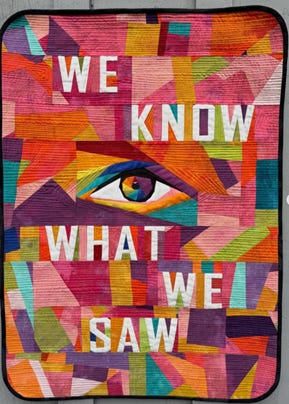
Many of these quilts were crafted as pieced statements, with their messages clearly conveying the maker’s point of view. One notable example is the quilt titled “We Know What We Saw” by Pam Brisse. This quilt resonated with me, as it captured the dissonance I experienced when comparing official explanations of ICE actions to video footage recorded by citizen observers. The quilt powerfully communicates the maker’s perspective on truth and accountability, emphasizing how quilting can be used as a medium for advocacy and personal expression.
On her Instagram post (@pamdorra) she writes “Because regular people are filming the atrocities with their phones, authoritarians are having a hard time lying to us…. I am overwhelmed by all the attention this project has received, and thankful to all of you for your enthusiasm and willingness to add your voices to it. Thank you for raising your voices with me. Let’s keep going.”
When viewed through the guiding principles of Kindness, Respect, and Inclusion, this particular social media post clearly aligns with these values, even while addressing a political subject. The tone of the post is not confrontational; instead, it expresses gratitude and appreciation for the support shown within the community. This approach embodies kindness by fostering a positive and supportive environment.
Furthermore, the post maintains respect by refraining from targeting or criticizing individuals who may hold differing opinions, including those who might support ICE. By avoiding divisive language or personal attacks, the message upholds a standard of professionalism and consideration for diverse viewpoints within the audience.
Finally, the post promotes an inclusive society by encouraging participation and recognizing the collective contributions of the community. The emphasis on unity and shared purpose reinforces a welcoming atmosphere where all members feel valued and heard, regardless of their backgrounds or beliefs.
In our country, recent laws have been enacted that exclude individuals who are transgender. There are situations where people, innocent of any wrongdoing, are forcibly taken off the streets by masked police officers simply because of their ethnicity. At the same time, the President has made derogatory remarks toward female reporters, calling them names such as “piggy.” These examples highlight a political climate that is often hostile and discriminatory.
Given these circumstances, it is evident that practicing kindness, respect, and inclusion is not always in harmony with the prevailing social and political environment. In fact, choosing to uphold these values can mean actively opposing injustice and exclusion. There are moments when it is necessary to take a stand that may be seen as political. That moment is now.
Until Next Time…
Margaret