

Rules
Do Artists have Rules?????

Below is a post from Rick Rubin here on Substack.
It’s a quote from his book “The Creative Act: A Way of Being”
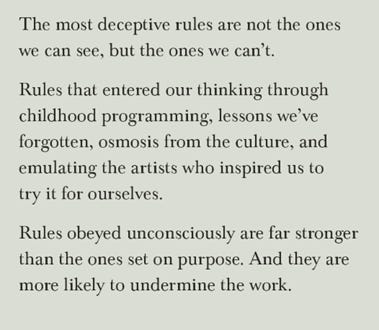
The quote from Rick Rubin’s “The Creative Act: A Way of Being” and a captivating YouTube video have inspired today’s post. The video, created by Joshua Charow—a photographer dedicated to documenting artist lofts in New York City and their aging residents—offers a fascinating glimpse into the lives and creative environments of artists who began their careers in the 1960s and 1970s.
The video, titled “How a Painter Couple Spent 65 Years Together in an NYC Loft,” features Judith Murray and her husband Robert Yasuda, both acclaimed artists. Their artistic journey began when they met at Pratt Institute 65 years ago. They have worked side by side ever since. Their work is held in prestigious collections, including the Metropolitan Museum of Art, the Whitney Museum, the Brooklyn Museum, and the Library of Congress.
What truly resonated with me was Judith Murray’s explanation of her artistic process. She described how, after visiting an exhibition of cave art at the Museum of Natural History, she was inspired by the display of ancient pots of pigment—red, black, white, and yellow ochre—used by early humans. This experience led her to establish a guiding rule for her own art: she would limit herself to just these four colors. Murray expressed that, for her, “everything I need is within those four colors.”
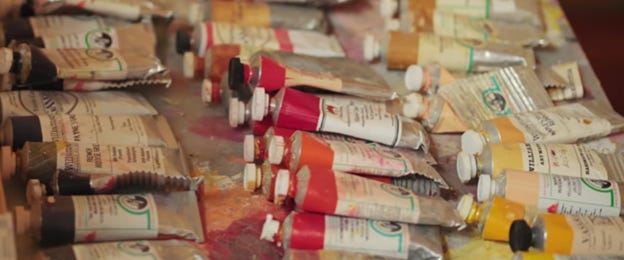
Murray further explained that this self-imposed constraint was not only a practical choice but also served as a profound connection, linking her work to all people across time. By working within this limited palette, she created a consistent thread throughout her art, emphasizing the universality and timelessness of creative expression.
This rule became the foundation for an exceptional body of work, demonstrating the immense creative potential that can arise from embracing limitations. Murray’s practice highlights the power of setting personal boundaries to explore ideas deeply and push the boundaries of one’s own creativity.
Judith Murray’s rule fits into the definition of a rule which Rubin writes in the opening lines of his chapter on Rules in his book “The Creative Act: A Way of Being”. He writes “A rule is a guiding principle or creative criterion. It might exist within the artist, the genre, or the culture. Rules by their nature are limitations.” Murry created a guiding principle for herself. A deeply held belief which resulted in an important body of work.
Rick Rubin’s words challenged me to reflect on the unconscious rules I’ve internalized as an artist. Growing up, I was surrounded by images of painters and sculptors—often portrayed as striving to faithfully recreate the world in front of them. I remember seeing depictions of Van Gogh painting outdoors, meticulously observing nature, which reinforced the notion that art should mirror the visible environment.
As I entered the art world, I noticed that cultural norms often link artistic success to commercial achievement and recognition by influential collectors. During my college years, I was particularly swayed by publications like Art Forum magazine, which spotlighted artists whose work appeared in renowned galleries or prestigious exhibitions like the Venice Biennale. These unconscious beliefs began to shape my own definition of success, subtly influencing my creative choices and sometimes imposing limitations on how freely I could express myself.
When I began my career as an artist after my bachelor’s degree studies, I established certain guiding principles for myself. My decisions must be influenced by economic considerations. A professor advised me that working within the public school system would provide higher compensation and greater job security. This path would also allow me ample time during summers and weekends to further develop my skills as a painter. Although I made a brief detour into the business world, I would eventually get my second degree in art education when my daughter was born and entered the public school system as an art teacher.
While teaching I continued to paint and pursued a master’s degree in visual arts. I carried with me an unconscious rule. A woman who was not living on either coast, raising children, and not attending a prestigious art school such as Yale, Pratt, or Rhode Island School of Design, would never earn a living as an artist. This rule was shaped by conventional wisdom and cultural expectations. Ultimately, I exchanged an artist’s life for another, accepting that my circumstances defined my possibilities. My guiding rule became: “I’ll grow where I am planted.” This mindset allowed me to find fulfillment and creative purpose within the life I had chosen, rather than striving for an ideal that seemed unattainable.
During the summers, I collaborated with fellow art teachers to create artwork that we would later exhibit at local coffee shops and small galleries throughout the school year. This experience led me to see myself more clearly as a mixed media artist. I explored new forms, such as crafting dimensional chickens from watercolored papers, designing butterflies displayed in shadow boxes and making abstract paper bah relief sculptures. Through this process, I gradually released my previous identity as a painter and embraced what is often considered low art or craft. I found fulfillment and creative freedom in these accessible, hands-on artistic expressions.
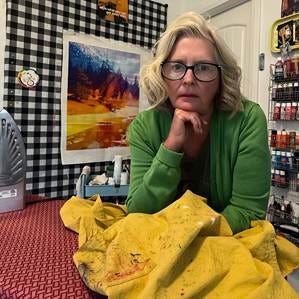
As I reflect on my journey, I recognize the profound impact of letting go of the rigid rules I once clung to as an eighteen-year-old. At that stage in my life, I believed that achieving success in art depended on following a prescribed path—attending a renowned art school, living in a vibrant city filled with galleries, and working within accepted artistic styles. These self-imposed guidelines seemed essential to becoming a true artist. I could never have predicted that it would take until my mid-fifties to begin a new chapter in the arts. Releasing those limiting beliefs has allowed me to see new possibilities and redefine what it means to be an artist, shaping my practice according to my own vision and terms.
Now, at the age of 66, I feel liberated enough to challenge any category, cultural expectation, or conventional markers of success. Rick Rubin’s insight resonates deeply: “It’s helpful to continually challenge your own process.” This openness empowers me to question not only external standards, but also the internal rules that once governed my creative choices, fostering a more authentic and fulfilling artistic life.
Until the Next Time…
Margaret