
Slow Looking
The question is not whether a picture is worth a thousand words, but whether it is worth more than a moment of our attention.

Like many of you, I spent part of the summer traveling somewhere beautiful. Now I’m back home, easing into my regular routine while still trying to hold on to that slower summer rhythm. One of my favorite ways to do that is by reading. I save articles from other Substack writers and then settle in with them during lazy mornings on the patio, when I have time to linger instead of skim. Recently, one by Elif Shafak caught my attention. It was titled “The Heart Has Its Reasons, Which Reason Knows Nothing Of” and it reminded me how much can open when we give ourselves permission to look, read, and think a little more slowly.
As an artist, I am fond of seeing Shafak’s selection of paintings, which she includes in her articles and connects to her ideas. In this piece, she opens with a 1510 portrait of a young man by Vincenzo Catena. I’ll admit the painting isn’t really my cup of tea. The figure sits squarely in the center, and his gaze feels a little lifeless to me. Shafak sees something very different. She loves the portrait and describes it as an image of innate serenity. It leaves her wondering who this young man was and what he might have been thinking as he sat for the painter.
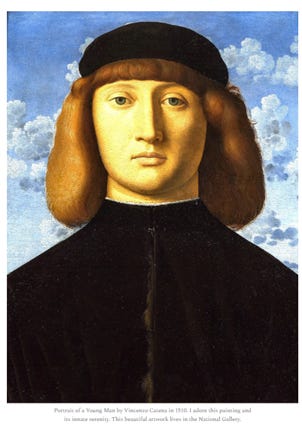
To me, her article is really about the challenge of making art in an age of immediacy, when attention spans feel shorter than ever. Shafak is asking how writers can find readers willing to slow down and spend real time with a book, but I think the question is beyond writing. Whether we are writers, visual artists, or musicians, it can be difficult to find an audience willing to sit with work that has intellectual depth, that is layered, complex, and not instantly understood. She makes this point by reflecting on the aphorism, a term I had not heard before reading her piece.
Since I wasn’t familiar with the term, I googled “aphorism” and its history. That search led me to one of the most enduring examples from the last century: “A picture is worth a thousand words.” The phrase was popularized by advertising executive Fred R. Barnard in the early 1920s, and it feels even more relevant now.
We live in a world where information reaches us in small, fast-moving headlines, captions, reels, and memes all competing for our attention. I understand the appeal of that immediacy. Images can be powerful because they meet us quickly, often before we have had time to think. But I keep coming back to the other side of it: sometimes a thousand words are exactly what an idea deserves. Some thoughts cannot be reduced to a clever phrase or a striking image. They need curiosity, patience, and enough time for a deeper understanding to unfold.
That is what draws me to the idea of slow looking. In a culture that rewards speed, slow looking asks us to do something almost countercultural: pause, stay present, and give our full attention full attention. A painting, a book, or a piece of music may not reveal itself all at once. It may need us to sit with it, return to it, and let its layers come forward gradually. For me, that is part of the pleasure of art. Depth is rarely immediate; it unfolds through time.
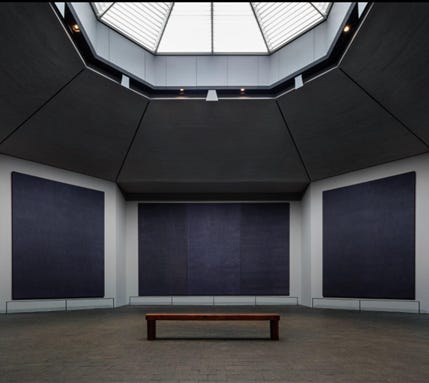
One of the places I keep thinking about when I think of slow looking is the Rothko Chapel in Houston. It was conceived in the 1960s, long before smartphones, social media, and the constant rush of today’s information age, yet it feels as if it was made for exactly this moment. The chapel invites a different kind of attention. Its fourteen monumental paintings do not give themselves away at first glance. You have to sit quietly, let your eyes adjust to the shifting light, and allow your mind to settle. Only then do the subtle colors and forms begin to emerge. For me, that is what makes the chapel so moving. It reminds me that not all meaning arrives quickly. Some experiences ask us to linger, to be patient, and to trust that depth will reveal itself if we are willing to stay with it.
I am finding myself on a similar journey in my own studio, searching for more complexity in my subject matter. In the past, my portraits were not unlike Catena’s Portrait of a Young Man: single figures, often looking straight ahead, with little narrative or conceptual depth. I began working with digital collage as a way to add more layers. Many of those pieces were portraits of my grandson, created for themed juried exhibitions. More recently, I have been working with photographic images from the Library of Congress, beginning with research into feminist history around the time I was born. That process has brought more intellectual depth into the work, and I believe that depth is beginning to come through to my audience.
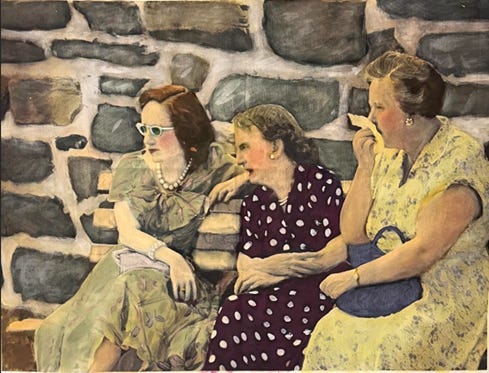
What I have discovered, much like Elif Shafak, is that when I spend time looking through images, I begin asking questions. And the more questions an image raises, the better. The work currently in my studio feels like a loose thread I keep pulling, each question tugging another one free until the whole image begins to unravel into possibility. It shows three women sitting on a park bench, and they seem to be from different generations. Maybe they are a daughter, a mother, and a grandmother. As they all look in the same direction, I find myself inventing a conversation in my mind. Maybe one of them is saying, “What is she wearing?” or “Do you think he’s really her husband?” Something a little saucy—not judgmental, just playful and full of curiosity.
So maybe the real question is not whether a picture is worth a thousand words, but whether it is worth more than a moment of our attention. As a visual artist, that is what I want to offer: not just technical mastery or beauty, but an image that asks the viewer to stay a little longer, to wonder, and to follow one question into the next. If the work can slow someone down long enough to keep looking, then perhaps it has done what art is meant to do.
Until next time…
Margaret
Love the new piece.