
The Artist Statement
A broad, professional artist statement matters because it helps gallerists, jurors, museums, and curators understand the work as serious art.

Almost two years ago, on June 24, 2024, I wrote about political art and the tensions I felt while living in deeply red Utah. A few opening lines from that post pulled me into an unexpected rabbit hole with an acquaintance.
Utah, in particular Southern Utah where I live, is MAGA territory. Not just traditional conservatives, but I would say a large number of those who support extreme positions on everything from gun rights to gay rights. I do not hold these beliefs and can’t put my mind around how anyone could. I try to not add fuel to the fire of negativity.
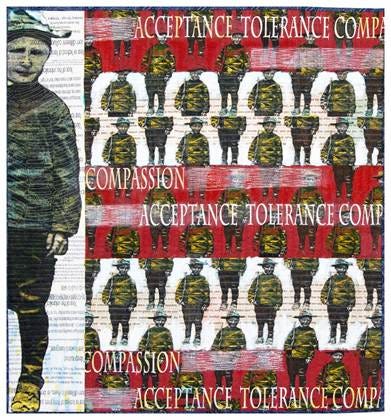
I have not changed my mind about the position I took as a citizen when I wrote that article. The person who criticized me for those views now moves in different circles, and I do not believe they will ever fully understand why I stand firmly in the Democratic camp: I am the mother of a queer son, as a teacher I personally understood the lasting impact of school shootings that began with Columbine and I support gun reform.
I am writing as the United States marks the 250th anniversary of declaring its independence from Britain. This week, I have seen a great deal of content across various platforms celebrating the Declaration of Independence. It made me realize how much I had forgotten about the document after decades away from school and more than ten years away from teaching. I took the time to reread the text.
The Declaration explained why a new country had to be formed. It identified the failures of British rule—abuses of power, laws imposed without representation, and a government that had stopped listening to its people—then outlined the principles of a different system. In that vision, authority came from the people, and government existed to protect their rights to life, liberty, and the pursuit of happiness. The Declaration was not only an announcement of separation; it was a statement of purpose for the nation being imagined.
Like the Declaration of Independence, an artist’s statement can outline a vision that has not yet been achieved. It is not only an explanation of the finished object; it is a record of what the artist is reaching toward. It gives shape to the ideas, experiences, tensions, and convictions that made the work necessary, while also naming the values the artist hopes the work will carry forward. A strong statement does not have to prove that the vision has been fulfilled. Instead, it declares the intention behind the work and invites the viewer to see it as part of something still unfolding.
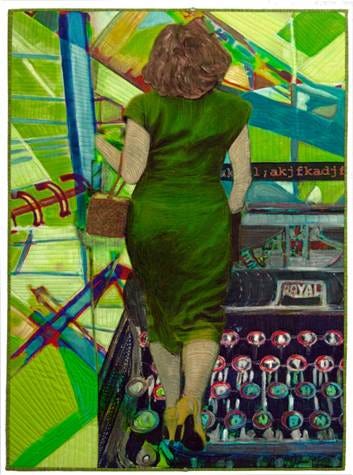
This year I applied and was accepted to create a solo exhibition which I titled Portraits on a Soft Canvas: A Conversation with History. Like all things, this application had a deadline. When I applied I pulled from my Google Drive prewritten sections of artist statements and an explanation of my process. If I was grading I would give myself a C+. That would have been generous.
My statement was focused on how I work, which is unique; but not the why. The ideas behind my process. I began describing the collection of images from the frame of history centered around the year I was born with a central female figure. Then I tacked on a general statement about my process:
I began working with a soft canvas hung on a wall in 2010 after being exposed to the textile art movement. My process has evolved over time. I begin with a small composition created from physical and digital layers. The work is printed commercially in larger format on linen cotton canvas on a grayscale. When the fabric arrives in my studio, the surface is painted in layers of glazed …….
The realization after I submitted the exhibition proposal is why I completely changed my artist statement. The version I had submitted may have been the best I could assemble under a deadline, but it stayed too close to the mechanics of my process. It described how I work without fully addressing why the work matters or what I am trying to understand through it.
I needed the statement to reach beyond technique and speak to the larger ideas behind the work: history, memory, identity, and the perspective I bring as a woman in her late sixties. My personal history and the history of this country have become source material for the images I make. I am creating not only to produce objects, but to better understand the world I have lived through and the questions that continue to shape me.
Time has become an increasingly visible presence in my work. I am aware that I am likely moving through the final third of my life, and that awareness has sharpened my attention to memory, change, and what remains. Yet my interest in time is not simply personal or chronological. It is also part of how I understand the world. Through history, observation, and the creative process itself, I continually return to the ways experience accumulates, fades, resurfaces, and leaves its mark.
A broad, professional artist statement matters because it helps gallerists, jurors, museums, and curators understand the work as serious art. This rewrite took a long time, even though my complete artist statement is shorter than this article. (You can find it on my website.) What the new statement gave me was a stronger frame for presenting my work beyond individual pieces or materials. It moved the conversation past the smaller world of art quilts, fabric, and textiles, and placed the work more clearly within the language of fine art.
That shift is also a form of preparation for the opportunities I hope to pursue, including more selective exhibitions like the one I described in my last post, “Art and Belonging.” These opportunities often require more than a general artist statement. They ask for a statement for each submitted piece, an explanation of how each work connects to the exhibition theme, and a broader statement of artistic purpose. Having that larger vision in place gives me more confidence when I am competing alongside artists who have already established themselves. It helps me present the work not only as process or material, but as part of a serious, sustained practice. That deeper understanding is already shaping new work, which I am eager to share in the future.
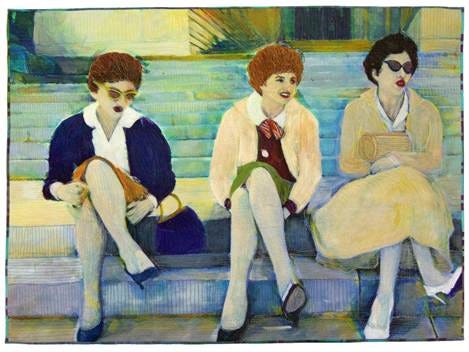
I will leave you with the final paragraph, which I am proud of because it expresses what I feel on a deeply emotional level, that time has shaped what I see, what I make, and what I choose to carry forward.
Rather than preserving a single fixed moment, my work acknowledges the passage of time and the quiet force it exerts on both art and life. The stitching is not merely decorative; it becomes a way of marking duration, tracing attention, and giving form to the slow accumulation of experience. Through painting and stitched cloth, I explore how memory settles into surfaces and how time continues to shape what we see, what we make, and what we carry forward.
Until Next Time
Margaret